What is Flowgate
What is Flowgate
Flowgate moves industrial data between systems that cannot talk to each other directly. It collects tags from field equipment, servers and brokers, normalizes every value into one common form, and routes it on to the systems that need it. Flowgate is an integration and data-routing layer. It is not a SCADA system and not a historian.
A Flowgate installation is one or more nodes. A node close to the plant floor collects from equipment and passes data to a node closer to the business network, which can pass it on again. A node can also serve what it holds through its own embedded OPC-UA server, so the data stays readable at each level. See Chaining and Reverse Connect for how nodes connect to each other.
The management console configures and monitors one node at a time, and can reach the nodes below it. See Getting Started for signing in and finding your way around it.
How Flowgate is deployed
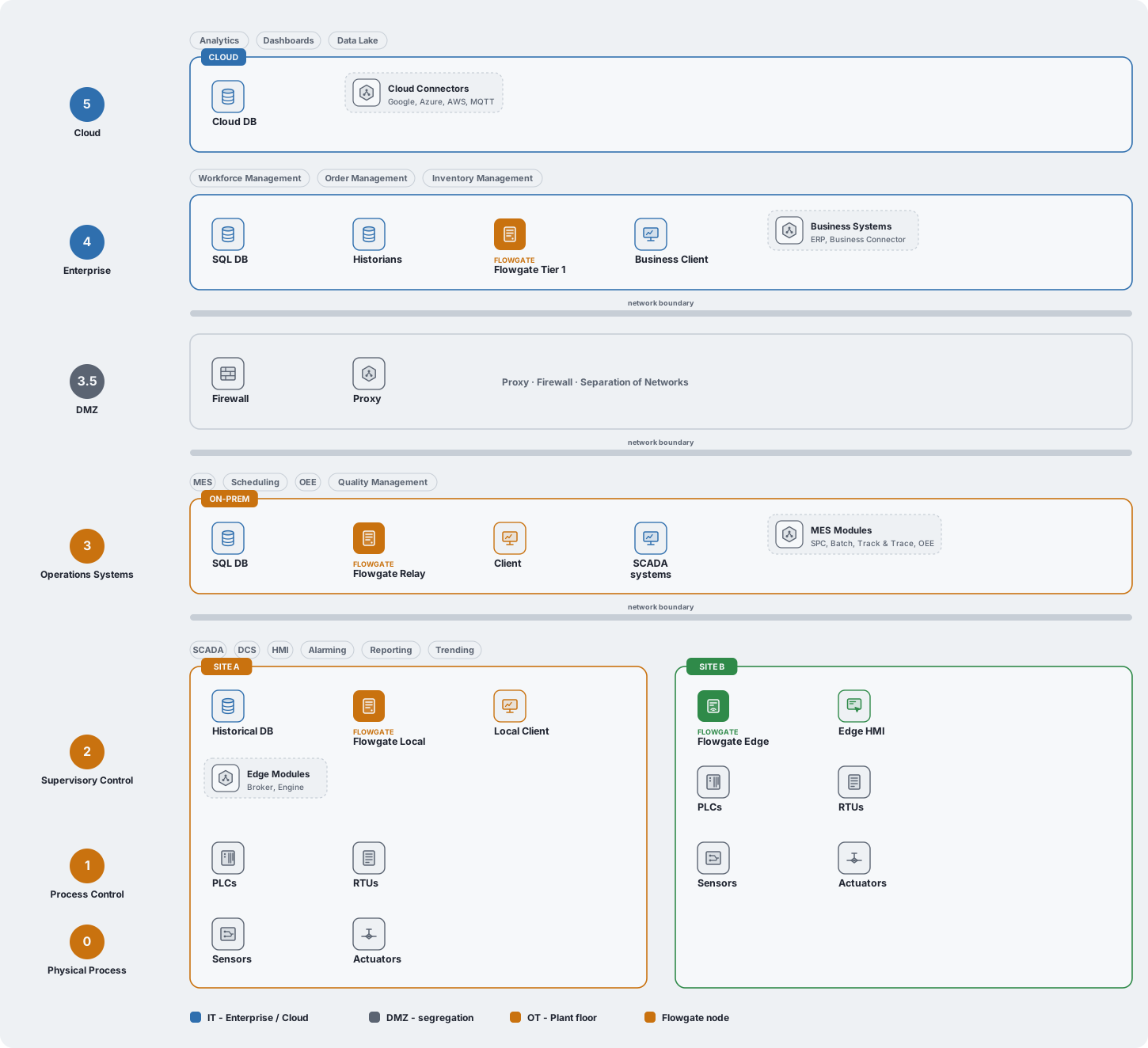
Flowgate runs the same binary at the Enterprise, Operations, and site levels (4 / 3 / 2), each configured for what it does there. Every node nearer the plant floor initiates an outbound OPC-UA Reverse Connect to the node above it, secured by mTLS, traversing the DMZ without a single inbound firewall rule on the OT network.
Related
- Getting Started: signing in and finding your way around the console.
- Chaining and Reverse Connect: how nodes link to each other and what a client sees.
- Store and Forward: what happens to data while a link is down.
Continue to Getting Started for how to sign in and find your way around the console.